Expert Cost Guide · Boksburg & East Rand
Ink Cartridges vs. Toner: What's the Difference and Which Saves You More?
How Businesses in Boksburg Can Cut Printing Costs by 50% Without Buying Cheap Counterfeits
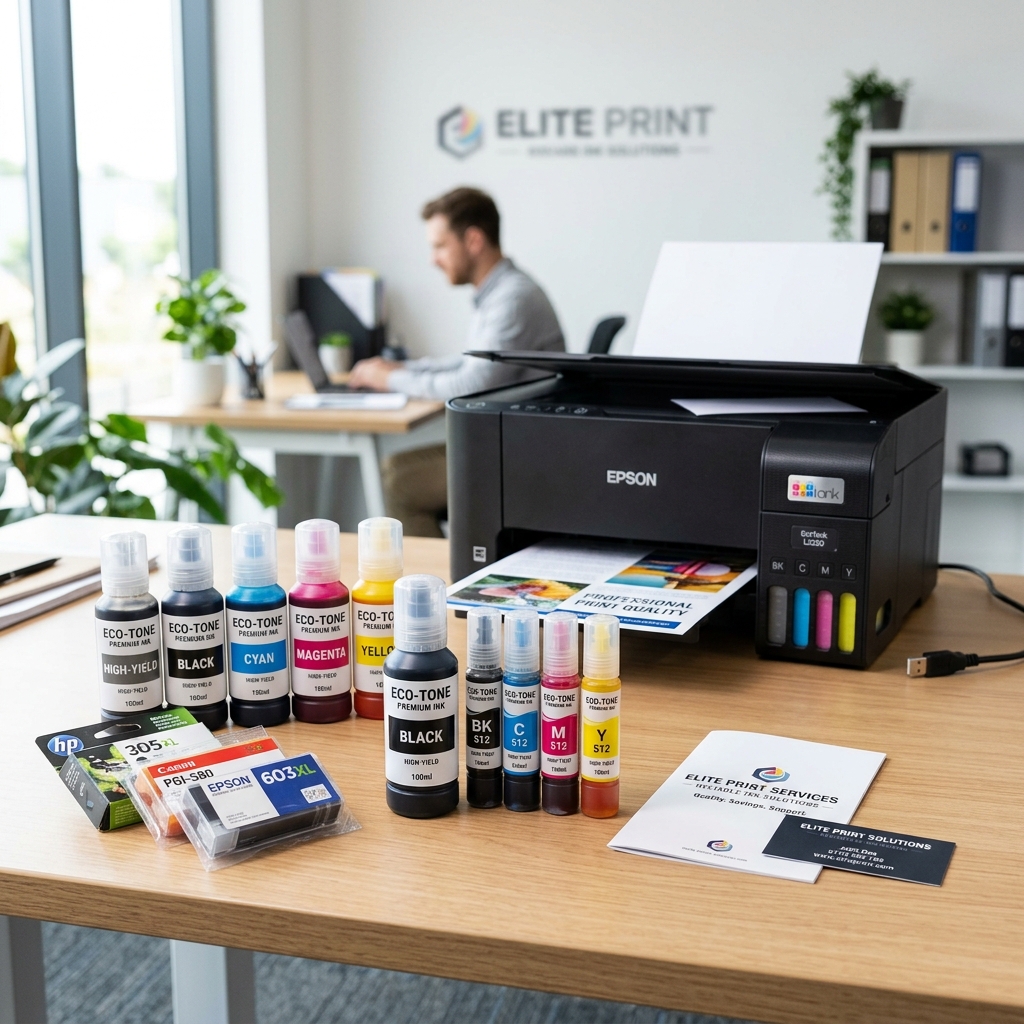
Every week we walk into Boksburg and East Rand businesses and see the same pattern: a printer that's costing far more than it should, owners who don't know their actual cost-per-page, and a cycle of cheap cartridges causing expensive damage. The ink vs. toner question is real — but the honest answer isn't as simple as picking a side. Volume matters, quality matters, and the South African operating environment creates failure patterns that change the calculation entirely. This is what we tell every client before they spend another rand on printing supplies.
In this guide
How inkjet and laser printing technology actually work
Inkjet printers spray microscopic droplets of liquid ink through nozzles onto paper — using either thermal (heat bubble) or piezoelectric (pressure pulse) mechanisms. Laser printers electrostatically charge a drum unit, attract dry toner powder to the charged areas, transfer it to paper, and permanently bond it using a heated fuser assembly. These are fundamentally different physical processes — and they create fundamentally different failure modes, maintenance requirements, and cost structures.
🖨️ Inkjet Technology
- Medium: Liquid ink in sealed cartridge
- Mechanism: Thermal or piezoelectric nozzles
- Paper contact: Ink absorbed into paper surface
- Key component: Print head (fixed or cartridge-integrated)
- Primary risk: Nozzle clogging from idle periods
- Best for: Photo printing, low-medium volume, colour detail
⚡ Laser / Toner Technology
- Medium: Dry powder toner in sealed cartridge
- Mechanism: Electrostatic charge + drum transfer
- Paper contact: Toner fused onto paper surface by heat
- Key component: Drum unit + fuser assembly
- Primary risk: Fuser wear, drum contamination
- Best for: High-volume text, business documents, speed
Why this matters in practice
The technology difference is not academic — it determines what breaks, what it costs to fix, and how the printer behaves under South African operating conditions. An inkjet's liquid ink dries in the nozzles during idle periods. A laser printer's fuser is vulnerable to South Africa's power quality fluctuations. Knowing the mechanism tells you what to protect.
Head-to-head: page yield, cost-per-page, and maintenance risks
The upfront price of a printer tells you almost nothing about what it will actually cost to operate. The metric that matters is cost-per-page (CPP) — what you spend in ink or toner for every single page printed. On this measure, inkjet and laser diverge significantly at different volume levels.
| Parameter | Inkjet (Ink Cartridge) | Laser (Toner Cartridge) |
|---|---|---|
| Technology | Liquid ink, thermal or piezoelectric nozzles | Dry powder toner, electrostatic drum, fuser heat |
| Best for | Photos, colour detail, under 200 pages/month | Text documents, high volume, speed |
| Upfront cost | Lower — R800–R3,000 for quality model | Higher — R2,500–R8,000+ for business model |
| Standard cartridge yield | 100–500 pages (standard), 500–1,500 (XL) | 1,000–3,500 pages (standard), 3,000–10,000+ (high yield) |
| Cost-per-page (mono) | R0.25–R1.20 depending on cartridge type | R0.08–R0.35 at typical business volumes |
| Idle risk (low use) | HIGH — nozzles dry out; clogging is permanent without intervention | LOW — toner powder does not dry out |
| Load shedding vulnerability | HIGH — idle periods accelerate drying | MEDIUM — fuser vulnerable to power spikes |
| Break-even volume | ~200 pages/month — below this inkjet can win on CPP; above this laser dominates | |
What cost-per-page actually looks like in rands
The honest Boksburg answer: ink vs. toner
After years of on-site work across Boksburg and the East Rand, the honest answer to "ink or toner?" is this: volume determines the technology, but cartridge quality determines the outcome. Get the quality wrong and the technology choice is irrelevant.
"The question I actually ask a client is: how many pages do you print in a month, and how often does the printer sit idle? Under 200 pages with consistent daily use — a quality inkjet can make financial sense. Over 200 pages, or any business where the printer sits unused for days at a time — laser is the right answer almost every time. But I've seen businesses with the right technology spending twice what they should because the cartridge quality is wrong. The cartridge matters as much as the machine."
Load shedding fundamentally tilts the ink vs. toner decision toward laser for most Boksburg businesses. When an inkjet printer sits unpowered for 2–4 hours during a load shedding cycle, the liquid ink in the nozzles begins to dry — particularly in Gauteng's dry winter months. A laser printer's dry powder toner is completely unaffected by power interruptions of any duration.
Not sure which technology suits your actual print volume? We'll audit it — free.
Call us in BoksburgThe cheap cartridge trap — what it actually costs Boksburg businesses
The most painful and preventable printing cost in the East Rand isn't the price of quality cartridges — it's the damage caused by cheap ones. Counterfeit and ultra-low-grade cartridges fail in three simultaneous ways: wrong ink chemistry, misreported yield, and residue that permanently damages print heads and drums.
"When a customer comes to us after using cheap cartridges, we find the same three things every time — clogged heads, smearing ink that won't bond, and a chip that claimed 300 pages when the cartridge ran dry at 60. All three. Simultaneously."
🚨 The three-way failure of cheap counterfeit cartridges
- Printhead residue that cleaning cycles can't shift: Counterfeit ink uses incorrect chemical formulations that leave particulate residue in the micro-channels of the print head. After weeks of use, the blockage becomes permanent. Print head replacement: R800–R2,000
- Wrong ink chemistry causes permanent bonding failure: Genuine ink is formulated to specific pH, viscosity, and surface tension values. Counterfeit ink doesn't meet these values — it sits on the paper surface, smears, and fades within days.
- Chip misreporting destroys yield expectations: The chip on a counterfeit cartridge reports a full ink level regardless of actual content. Businesses receive a fraction of the stated page yield — often 20–30% of what's claimed on the box.
| Cost Factor | Cheap / Counterfeit | OEM Original | Certified Remanufactured |
|---|---|---|---|
| Purchase price | R49–R120 | R180–R600+ | R90–R280 |
| Actual page yield | 20–30% of stated | 100% of stated | 90–100% of stated |
| Printer damage risk | HIGH — printhead & drum | None | None when quality-certified |
| 12-month TCO (500 pg/month) | R4,200–R8,000+ (incl. repairs) | R3,600–R5,500 | R1,800–R2,800 |
A cheap cartridge at R60 that delivers 60 pages costs R1.00 per page. A certified remanufactured cartridge at R150 that delivers 500 pages costs R0.30 per page. Before the repair bill. The cheap option isn't cheap — it's just a deferred cost with a larger number attached.
Counterfeit vs. certified remanufactured: the distinction Boksburg businesses don't know about
Most Boksburg business owners operate with a false binary: OEM (original, expensive, safe) or generic (cheap, risky). The certified remanufactured category sits between them — delivering OEM-equivalent quality at 40–60% below OEM pricing.
What "certified remanufactured" actually means
- Original OEM cartridge shell — not a new generic housing. The same cartridge the manufacturer produced, disassembled and restored.
- Professional cleaning — all residual ink or toner removed from every component before refilling.
- Brand-matched ink or toner — formulated to meet the specific viscosity, particle size, pH, and fusing temperature requirements of the target printer model.
- Correctly programmed chip — reset or replaced with a chip that accurately reports ink levels.
- Quality tested before sale — nozzle check or test print confirmed before the cartridge leaves the facility.
- Yield guarantee — a certified remanufacturer stands behind the page yield. A counterfeit seller does not.
Want certified remanufactured quality delivered and tested on-site in Boksburg?
Book your visitThe proven 50% cost reduction strategy for Boksburg businesses
Two strategies together reliably achieve 40–50% printing cost reduction without touching cheap supplies, without changing printers, and without compromising print quality.
Conduct a proper print audit first
Most businesses have no idea what they actually spend on printing. Before changing anything, establish your baseline: how many pages per month, what percentage is colour vs. mono, what cartridges you're buying, and what your actual cost-per-page is. We carry out free print audits for businesses across the East Rand.
Switch to high-capacity XL cartridges immediately
If you're buying standard-yield cartridges, this single change typically delivers a 30–45% cost-per-page reduction overnight. A standard HP 305 black cartridge yields approximately 120 pages. The HP 305XL yields 240 pages at roughly 1.6× the price — a 33% CPP reduction from one product swap with zero change to print quality or workflow.
Set monochrome as your default print mode
Colour printing costs 3–8× more per page than mono. Most business documents don't require colour. Setting the printer default to monochrome typically cuts colour print volume by 60–80%. Combined with the cartridge strategy, this pushes the total saving past the 50% mark for most businesses.
Replace OEM cartridges with certified remanufactured alternatives
Switching from OEM to certified remanufactured cartridges from a quality supplier adds a further 40–60% saving on consumable costs. The key requirement: the supplier must use brand-specific ink formulations, reset chips correctly, test before delivery, and offer a yield guarantee.
Frequently asked questions
What is the difference between ink cartridges and toner cartridges?
Ink cartridges contain liquid ink sprayed through nozzles — used in inkjet printers. Toner cartridges contain dry powder electrostatically transferred to paper and bonded by heat — used in laser printers. Inkjet has lower upfront cost but higher CPP and clogs when idle; laser costs more upfront but delivers dramatically lower CPP at volume.
Is inkjet or laser better for a small business in South Africa?
For most South African small businesses printing more than 200 pages per month, laser delivers better total cost of ownership. In South Africa, load shedding makes inkjet printers particularly vulnerable — idle periods during power outages accelerate nozzle clogging. The cartridge quality ultimately matters as much as the technology choice.
Why are cheap counterfeit printer cartridges bad for your printer?
Cheap counterfeit cartridges damage printers in three ways simultaneously: incorrect ink chemistry clogs printheads beyond what cleaning cycles can clear; wrong bonding properties cause smearing; and chips misreport yield, delivering a fraction of the stated page count. Combined, they void warranties and cause R800–R2,000+ in repair costs.
What is a certified remanufactured cartridge and is it safe?
A certified remanufactured cartridge is a professionally restored OEM shell, refilled with brand-matched ink or toner, fitted with a correctly programmed chip, and quality-tested before sale. It costs 40–60% less than OEM and delivers equivalent yield and quality without damaging the printer.
How can a Boksburg business cut printing costs by 50%?
Two strategies together achieve 40–50%: conduct a print audit to establish your actual CPP and volume baseline, then switch from standard-yield to high-capacity XL cartridges. Adding a default monochrome print setting and switching to certified remanufactured cartridges from a quality supplier pushes the saving past 50% for most businesses.
Ready to cut your printing costs by 50%?
Start with a free audit.
Cartridge Mobile Clinic carries out free print cost audits for businesses across Boksburg and the East Rand. We establish your actual cost-per-page, identify exactly where the waste is, and give you a clear plan to cut it — using certified remanufactured cartridges, XL formats, and on-site refilling. No cheap counterfeits. No guesswork. Just the maths.