Expert Buyer's Guide · Boksburg & East Rand
Finding Reliable Cartridge Refill Services Near You: What to Look For
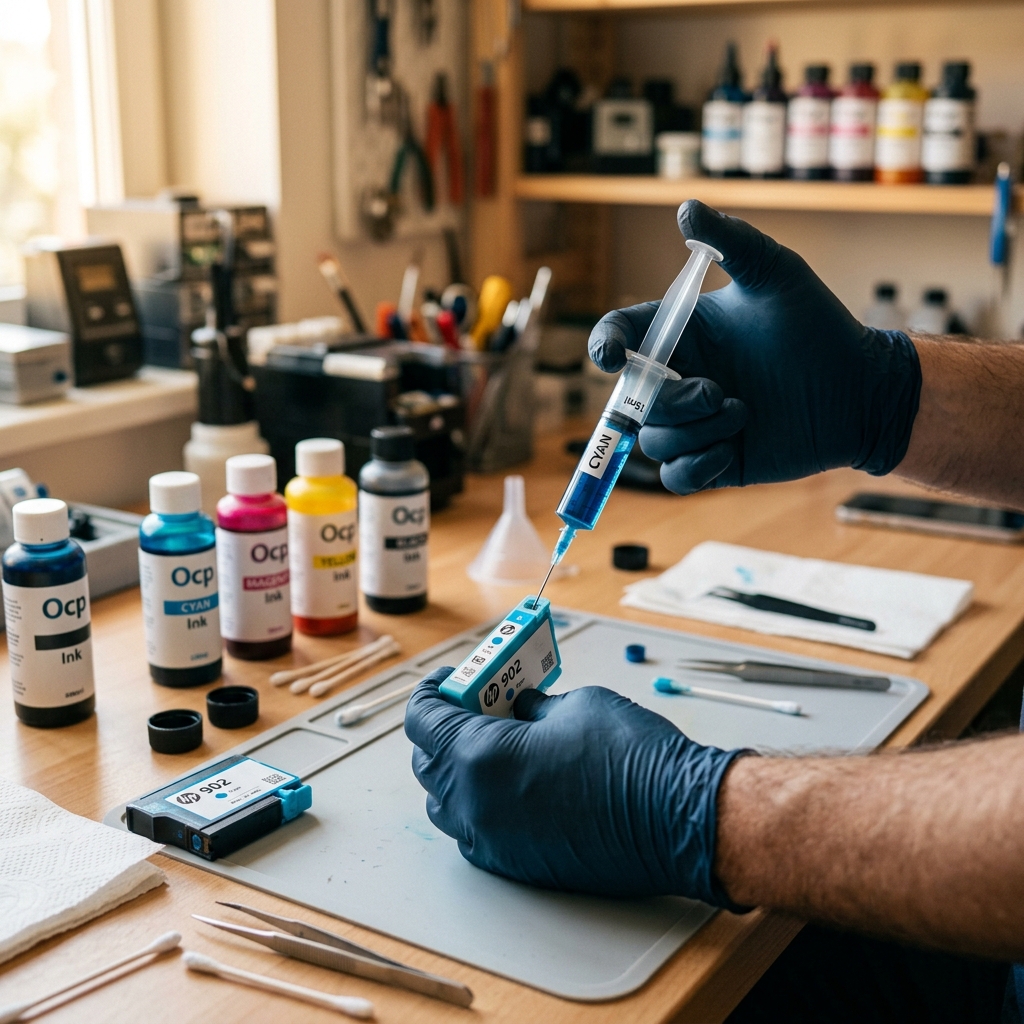
A cartridge refill should save you money. When it's done correctly — with brand-matched ink, a properly reset chip, and a tested yield — it costs 40–60% less than a new OEM cartridge and prints just as well. When it's done badly, you get ink leaking into your printer drum, a cartridge your printer refuses to recognise, and 20 pages of faded output before it dies completely. The difference isn't luck. It's what to ask before you hand over a single cartridge.
🚨 What a bad refill actually costs you
- Ink leaking into the drum unit — R700–R1,500 to repair or replace
- 20 pages of poor yield instead of 300+ — money wasted, problem not solved
- "Cartridge not recognised" error — chip wasn't reset correctly
- Streaky, faded prints from wrong ink spec — reprints, wasted paper, missed deadlines
- Print head clogged from incorrect viscosity — R600–R1,200 to service or replace
Every one of those outcomes has the same root cause: the refill service didn't use the right ink for your printer, didn't reset the chip properly, or didn't test the cartridge before handing it back. Here are the six questions that separate reliable refill services from the ones that damage your equipment.
The 6 questions to ask any cartridge refill service
Question one
"Do you use brand-specific ink — or a universal formula?"
This is the most important question — and the one almost nobody asks. Most cheap refill shops use a single generic ink formula across every brand and model. It's cheaper to stock, easier to manage, and completely wrong for your printer.
Here's why it matters technically: every printer brand has unique internal tolerances that its ink is engineered to meet precisely. Generic ink doesn't meet any of them.
| Brand | What generic ink gets wrong | What it causes |
|---|---|---|
| HP | Incorrect viscosity — too thick or too thin for thermal inkjet heads | Clogged nozzles, intermittent printing, permanent head damage |
| Canon | Wrong particle size for micro-droplet PIXMA technology | Blocked micro-channels, banding, colour inaccuracy |
| Brother | Toner not calibrated to fuser temperature spec | Toner doesn't bond to paper — smearing, ghosting, fuser contamination |
| Epson | pH imbalance in ink chemistry | Accelerated nozzle corrosion, colour drift, reduced head life |
A professional refill service maintains separate brand-matched ink formulas for each manufacturer — because that's what each manufacturer's hardware requires.
Ask exactly this:
"What ink formula do you use for my specific brand? Is it matched to HP / Canon / Brother spec — or is it a universal ink?"
Question two
"How do you handle the chip — and can you reset it for my model?"
Modern printer cartridges contain a small microchip that communicates ink level data to the printer. When a cartridge is refilled without resetting this chip, the printer still thinks the cartridge is empty — and either refuses to print or throws a "cartridge not recognised" error regardless of how much ink is inside.
Chip resetting requires model-specific tools. An HP 67 chip is reset differently from an HP 305. A Canon PG-545 is different from a PG-560. A service that resets chips correctly has the right equipment for your exact cartridge — not a generic workaround that may or may not hold.
Ask exactly this:
"Do you reset the chip, or replace it? Do you have the right tool for my specific cartridge model number?"
Want a refill done right the first time — at your door?
Book your visitQuestion three
"Do you test the cartridge before I leave — or take it home?"
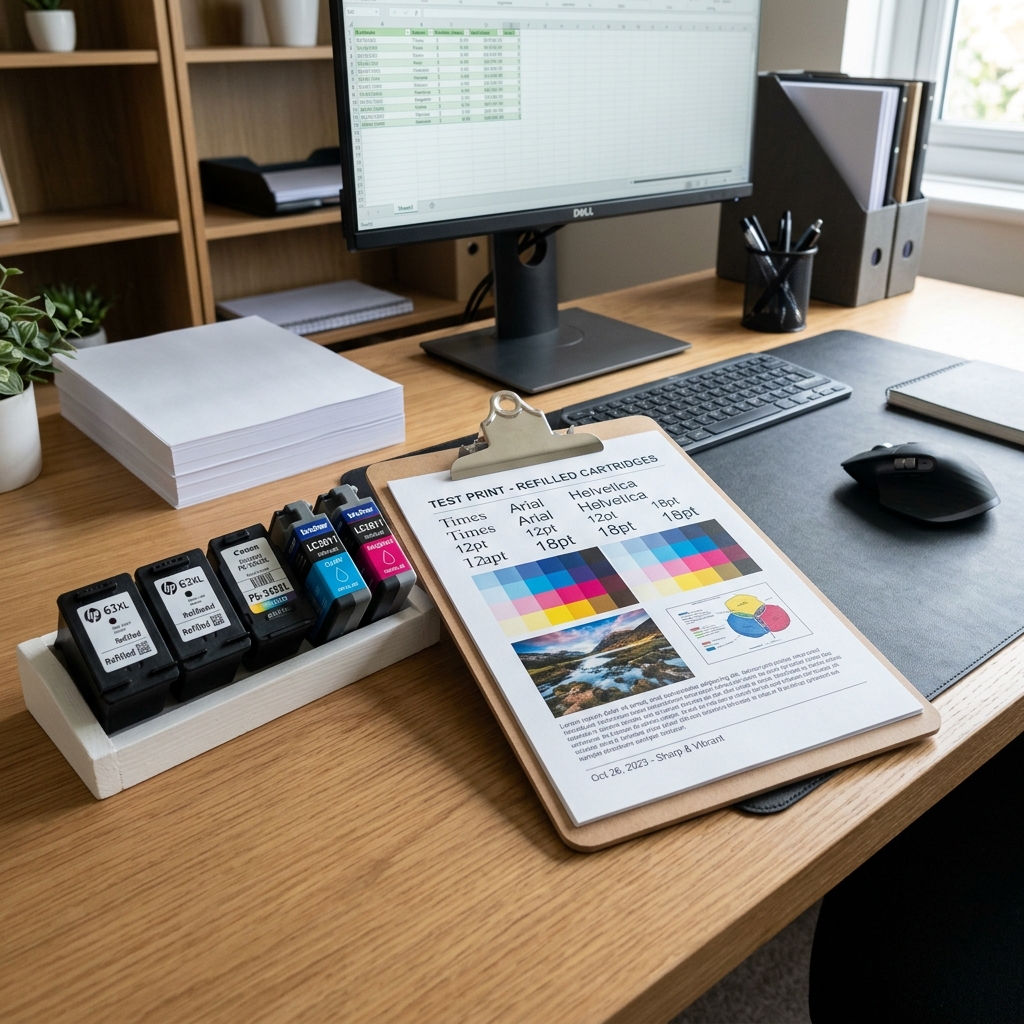
A cartridge that looks filled and has a green chip light is not necessarily a cartridge that prints correctly. A professional service prints a nozzle check or test page after every refill — before the cartridge leaves their hands. This confirms ink flow, colour accuracy, and that the chip is communicating correctly with the printer.
A service that hands you a refilled cartridge without testing it is asking you to be their quality control. If something is wrong, you only find out when you get home, install it, and watch it fail — at which point you're back to square one with wasted time and a printer that still doesn't work.
Ask exactly this:
"Do you run a print test on every cartridge before handing it back? Can I see the test print?"
Question four
"What page yield can I expect — and do you guarantee it?"
Page yield is the number of pages a cartridge will print before it runs out. OEM cartridges publish their yield — an HP 305XL, for example, is rated at approximately 200 pages for black. A quality refill should match or come close to that yield. A cheap refill that uses low-grade ink or underfills the cartridge might deliver 40–60 pages before failing.
A service confident in their work will guarantee the yield. If the cartridge runs out significantly earlier than the expected output — they should make it right. If they won't commit to a yield guarantee, that tells you everything about the quality of what they're putting in.
Ask exactly this:
"What page yield should I expect from this refill? Do you guarantee that, and what happens if I get significantly fewer pages?"
Question five
"Do you come to me — or do I need to come to you?"
Most people assume they have to take their cartridge — or their printer — to a shop. This costs time, introduces the risk of the cartridge being damaged in transit, and means you're relying on a test done on a shop printer rather than your own.
On-site refilling is the better model. The technician comes to you, uses your printer to test the cartridge, and confirms everything is working correctly in your actual setup before leaving. Any compatibility issue — a chip that needs a second reset, a setting that needs adjusting — is caught and fixed on the spot rather than discovered later when you're trying to print something important.
Ask exactly this:
"Do you offer on-site service where you come to my home or office? What areas do you cover, and how quickly can you get to me?"
Question six
"What happens if something goes wrong after the refill?"
Things occasionally go wrong even with professional refills. A chip that held on the test print sometimes resets to zero after the first power cycle. An ink channel that printed cleanly on first use occasionally develops a minor blockage within 24 hours. These are rare — but they happen.
What separates a professional service from a dodgy one isn't whether problems occur — it's how they handle them when they do. A reliable service has a clear process: contact them, they assess, they fix. No arguments, no finger-pointing, no "you must have done something wrong."
Ask exactly this:
"If I have a problem with the refill after you've left — print quality, chip errors, anything — what's the process? Do you come back out?"
Red flags that tell you to walk away
🚩 Do not use a cartridge refill service that:
What a guaranteed refill actually looks like
Here's exactly what Cartridge Mobile Clinic includes on every single refill — not as extras, but as standard. This is the benchmark to hold any service to.
Every Cartridge Mobile Clinic refill includes:
Your cartridge refill service checklist — save this
✅ Before booking any refill service, confirm:
Frequently asked questions
Where can I find cartridge refill services near me in Boksburg?
Cartridge Mobile Clinic offers professional on-site cartridge refilling across Boksburg and the East Rand. We come to your home office or business, refill and test on your printer, and guarantee both quality and yield. HP, Canon, Brother, and Epson — all major brands covered.
What should I look for in a reliable cartridge refill service?
Six things: brand-specific ink, correct chip reset for your model, a test print before the cartridge leaves the service, a page yield guarantee, experience with your brand, and a clear process for post-refill issues. A service that can't answer all six confidently is a risk to your printer.
Why is brand-specific ink important for cartridge refills?
HP, Canon, Brother, and Epson each have unique tolerances that generic ink can't meet. HP needs specific viscosity, Canon PIXMA heads require precise particle size, Brother toner must match fuser temperature calibration, and Epson heads are sensitive to ink pH. Generic ink ignores all of this and causes clogging, leaking, or poor bonding — damaging your printer over time.
How do I know if a cartridge refill will damage my printer?
The main risks are wrong ink spec, an incorrectly reset chip, and overfilling. A professional refill service uses brand-matched ink, model-specific chip reset tools, and tests the cartridge before handing it back. If a service can't tell you what ink formula they use or how they reset the chip — don't use them.
Is cartridge refilling cheaper than buying new cartridges?
Yes — a professional refill costs 40–60% less than an OEM cartridge while delivering equivalent yield and quality. The key word is professional. A cheap refill that leaks, yields 20 pages, or damages your print head is not a saving — it's a hidden cost that usually exceeds the price of an OEM cartridge several times over.
Can I get printer cartridges refilled at home in Boksburg?
Yes — Cartridge Mobile Clinic provides on-site cartridge refilling across Boksburg and the East Rand. We come to you, use brand-specific ink, reset the chip correctly, test on your printer before we leave, and guarantee the yield and quality. No transport, no waiting.
The right ink. The right chip reset.
Tested on your printer. Guaranteed.
Cartridge Mobile Clinic refills HP, Canon, Brother, and Epson cartridges on-site across Boksburg and the East Rand. Brand-specific ink. Model-specific chip reset. Test print before we leave. Yield and quality guaranteed — or we come back and fix it.